Matala: The Hippie Haven and Ancient Port of Crete's Southern Coast
Introduction
Tucked into a curving bay on the southern coast of Crete, Matala is one of those rare places where mythology, ancient history, and modern legend all share the same beach. The famous cliffs that frame its sandy shore are riddled with man-made caves carved more than two thousand years ago, and those same caves became the symbol of an entirely different era in the late 1960s, when international hippies turned the village into one of the most iconic counterculture destinations in Europe.
Today Matala is a small, friendly seaside village in the Heraklion regional unit, roughly 70 kilometres south of Heraklion city and just nine kilometres south-west of the great Minoan palace of Phaistos. It has grown beyond its hippie days into a popular holiday spot, but it has never lost its distinctive character. Visitors come for the turquoise water, the dramatic sandstone cliffs, the famous Matala caves, and the lingering atmosphere of free-spirited 1960s romance that the village still proudly celebrates every summer at its colourful Matala Beach Festival.
Geographic Setting
Where Matala Is Located
Matala lies in the Mesara region of southern Crete, on the eastern shore of the Gulf of Messara, which opens out to the Libyan Sea. The village sits at the western end of a small but very picturesque cove, enclosed by tall sandstone cliffs to the north and rolling hills to the south. Behind the village stretches the fertile Mesara plain, the largest agricultural plain on the island, dotted with olive groves, vineyards and small traditional villages.
The drive from Heraklion takes about an hour and twenty minutes by car, passing through the historic town of Mires and the archaeological sites of Gortyna and Phaistos along the way. This makes Matala an excellent base, or a perfect day-trip destination, for travellers who want to combine swimming and sightseeing in a single relaxed itinerary.
Climate and Landscape
Matala enjoys one of the warmest and sunniest climates on Crete, which itself is one of the sunniest parts of Europe. The southern coast generally sees milder winters and longer summers than the north, with the swimming season often stretching from late April well into October. The sea here is famously clear, with a deep blue colour produced by the steep underwater drop just a few metres from shore.
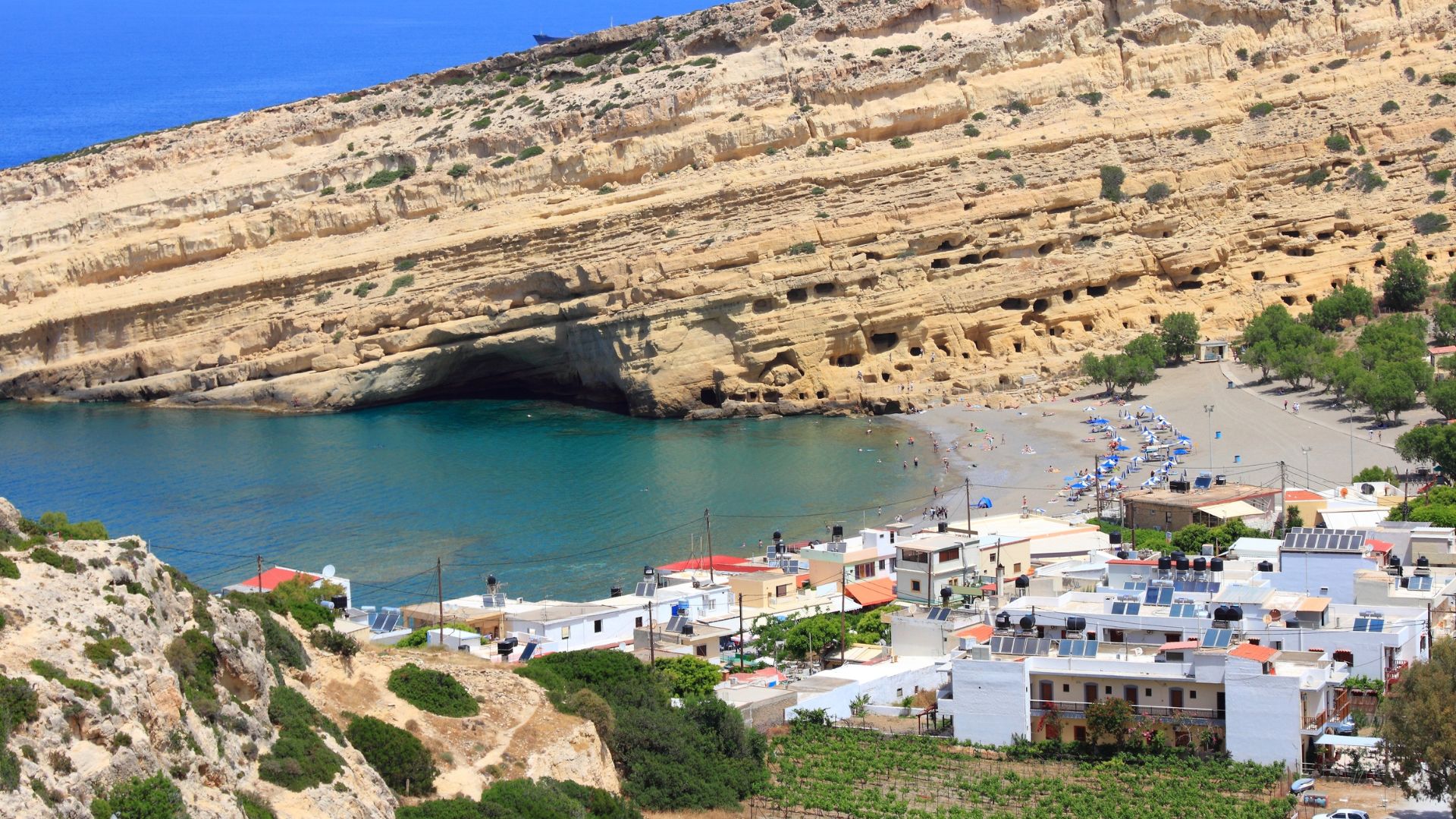
The landscape is dominated by the soft, golden sandstone cliffs on the north side of the bay. These cliffs, eroded by wind and waves over thousands of years, are exactly what made it possible for ancient inhabitants to carve the famous caves that have become Matala's signature image.
The Ancient History of Matala
Mythology: The Arrival of Europa
Long before Matala had a single house, it had a myth. According to one of the most famous stories in Greek mythology, the bay of Matala is the very place where Zeus, disguised as a magnificent white bull, came ashore carrying the Phoenician princess Europa on his back. Zeus had fallen in love with Europa while she was gathering flowers near the sea in her homeland of Tyre. He transformed himself into a gentle, beautiful bull, and when Europa approached and climbed onto his back, he plunged into the sea and swam all the way to Crete.
The myth says that Zeus brought Europa ashore at Matala and then carried her inland to the area of Gortyna, where she gave birth to three sons: Minos, the legendary king of Crete; Rhadamanthys, a famously wise lawgiver; and Sarpedon, a hero who later fought in the Trojan War. From these sons came the entire mythological royal line of Crete, and ultimately, through the name of Europa, the name of the European continent itself. Few small villages anywhere in the world can claim a mythological origin story of such global significance.
Matala in the Minoan and Greek Periods
Although Matala itself was a small settlement, its location made it strategically very important throughout antiquity. During the Minoan period, when the great palace at Phaistos was at its height, Matala served as one of the harbours used by the Minoans for trade across the Libyan Sea and toward Egypt and North Africa. The Minoans were skilled seafarers, and the sheltered bay of Matala provided a safe anchorage on an otherwise often rugged southern coast.
Later, in the Classical and Hellenistic periods, Matala continued to function as a port, this time serving the powerful inland city of Gortyna. Gortyna would eventually become the most important city of Crete and, under Roman rule, the capital of the joint Roman province of Crete and Cyrenaica. As Gortyna grew, so did the importance of Matala as one of its two principal harbours, together with nearby Lebena.
The Roman Era and the Carving of the Caves
Roman influence on Crete became firmly established in 67 BCE, when the consul Quintus Caecilius Metellus completed the Roman conquest of the island. From that point onward, Gortyna flourished as a major Roman administrative centre, and Matala became one of its busiest seaports. Ships sailed from Matala to Egypt, North Africa, Cyrenaica and beyond, carrying agricultural produce, olive oil, wine and other goods.
It was during the late Roman period, between roughly the first and second centuries CE, that most of the famous caves of Matala were carved into the soft sandstone cliffs on the north side of the bay. These caves were not originally homes. They were, in fact, Roman-era tombs, hewn out of the rock as a necropolis for the inhabitants of the area. Many of them have rectangular niches inside, which were used as graves, and some show traces of small steps, benches and architectural details that reveal their funerary purpose.
Over the following centuries, after the Roman world began to decline, the original use of the caves was largely forgotten, and people began to reuse them for very different purposes.
Early Christian, Byzantine and Pirate Eras
Christian Hermits and Refuges
From the Early Christian and Byzantine periods, the caves of Matala took on a new life as shelters for hermits, monks and ordinary villagers. The cliffs offered natural protection, were close to fresh water, and were easy to defend. Small chapels and religious symbols were carved into some of the cave walls during this time, and the area remained quietly inhabited even when the broader Mediterranean was experiencing major upheavals.
This long, slow shift from Roman necropolis to Christian refuge is a typical pattern in many parts of Crete, where ancient structures were continuously reused and reinterpreted by later generations. The caves at Matala are one of the most visually striking examples of this layered history.
Venetian Rule and the Pirate Centuries
From 1204 to 1669, Crete was ruled by the Republic of Venice. During this long period the southern coast of the island was constantly threatened by pirates, especially after the rise of the Barbary corsairs based in North Africa. The sheltered bay of Matala was both a blessing and a curse: it offered safe anchorage to local fishermen, but it also made an attractive landing point for raiders.
As a result, much of the surrounding population moved inland to safer, hidden villages such as Pitsidia, which sits a few kilometres up the road and remains a charming traditional settlement to this day. Matala itself shrank during these centuries to little more than a tiny fishing hamlet, and remained that way for a very long time, all the way through the period of Ottoman rule and into the modern era.
The Hippie Era: Matala in the 1960s and 1970s
The Arrival of the Counterculture
In the mid-1960s, the global counterculture movement was looking for warm, beautiful, inexpensive and somewhat remote places where young travellers could live cheaply, free from the conservative pressures of their home societies. The overland route from northern Europe to India was opening up, and Crete became one of the favourite stops along the way. Matala, with its empty caves overlooking a perfect sandy beach, turned out to be exactly what they were looking for.
The first hippies began arriving around 1965 and 1966. Word spread quickly through the international traveller grapevine, and by the late 1960s and early 1970s Matala had become one of the most famous hippie destinations in the entire Mediterranean. At its peak, several hundred young people from across Europe, North America, Australia and beyond were living in the Roman caves, swimming naked in the bay, playing guitars on the beach and gathering each evening to share food, stories and music.
Famous Musicians and Travellers
Many famous artists either visited Matala or are strongly linked to its hippie story. Joni Mitchell, the Canadian singer-songwriter, stayed in Matala in 1970 and lived for a time in one of the caves with a red-bearded American traveller named Cary Raditz. Her experiences there became the inspiration for the song "Carey" on her landmark 1971 album Blue, where she mentions the "Mermaid Cafe" — a real beach taverna in Matala — and the bright wind blowing down from Africa. Few songs have done more to put a single small village on the global cultural map.
Cat Stevens (now known as Yusuf Islam) is another musician strongly associated with the Matala scene of that era, and his song "Matthew and Son" is sometimes mistakenly linked to the village, although the references in his music to Mediterranean life draw on his own travels through Greece. Local legend, repeated by many older residents of Matala and Pitsidia, also places Bob Dylan and Janis Joplin in the village during the same period, although the documentary evidence for those particular visits is less certain. What is certain is that the atmosphere of the place attracted artists, writers, photographers and free thinkers of all kinds.
Daily Life in the Caves
Life in the Matala caves was simple, communal and improvisational. The caves themselves are small, often just a few square metres, with low ceilings and the original rectangular Roman tomb niches still visible in the walls. Hippies decorated them with carpets, candles, sleeping bags and personal belongings, and many of the caves were given names that are still remembered locally today.
Days were spent on the beach, in the sea, or walking to nearby coves such as Red Beach, which lies a short hike over the headland to the south and offered even greater privacy. Food was bought from the small local shops and from the village's few tavernas, where the local Cretan families, initially surprised by their new long-haired guests, gradually developed a warm and tolerant relationship with them. Locals often describe the hippies of that era with affection: they were generally peaceful, respectful and grateful, and they brought money and life into what had been a very quiet corner of the island.
The End of the Hippie Era
The hippie era at Matala did not last forever. As the 1970s progressed, the Greek authorities became increasingly uncomfortable with the international scene that had developed in the caves. The military government of Greece at the time disapproved of the lifestyle, and the local church also raised objections. By the mid-1970s, the caves were officially cleared and declared a protected archaeological site, which they remain to this day.
Many of the original hippies moved on, some travelling further east, others returning home, and a few choosing to stay in the area and build new lives in Matala and the surrounding villages. The era left a deep mark on the village that is still very visible: in the colourful murals along the main street, in the names of the cafes and tavernas, in the famous "Today Is Life, Tomorrow Never Comes" sign at the entrance to the village, and in the annual Matala Beach Festival that brings the spirit of the 1960s back to life every summer.
Matala Today
The Village and the Beach
Modern Matala is a small, friendly village with a permanent population of only a few hundred people, which swells dramatically in the summer with visitors from all over the world. The village centre is essentially a single pedestrian street lined with tavernas, cafes, bakeries, souvenir shops and small guesthouses, leading down to the main beach.
The beach itself is a beautiful crescent of soft sand and pebbles, about 300 metres long, with crystal-clear water that deepens quickly and is famously good for swimming. The dramatic cliffs with the caves rise directly to the north, and a smaller rocky headland closes the bay to the south. Sunbeds and umbrellas are available for hire, and the beach is generally clean, well-organised and well-supervised by lifeguards in the high season.
Visiting the Famous Caves
The Matala caves are now an official, fenced archaeological site managed by the Greek Ministry of Culture. There is a small entrance fee, and the site is generally open from morning to early evening, with longer hours in the summer. Visitors can walk along the carved paths in the cliff face and look inside many of the caves, where the original Roman tomb niches and a few faint Christian carvings are still clearly visible.
Climbing on the cliffs or sleeping in the caves is no longer allowed, both for safety reasons and to protect the archaeological remains. The view from the caves out over the bay, however, remains one of the most photographed sights on the entire island of Crete.
The Matala Beach Festival
Every year, usually in late June, Matala hosts the Matala Beach Festival, a free three-day event that celebrates the village's hippie heritage with live music, art, food, dance and a deliberately laid-back atmosphere. Greek and international musicians perform on a large stage right next to the cliffs, and the village fills with thousands of visitors of all ages. It is one of the most popular and distinctive summer festivals in Crete, and one of the best times of the year to experience the unique spirit of Matala.
Things to See and Do Around Matala
Red Beach
A 20 to 30 minute walk south over the headland from Matala brings you to Red Beach, named for the rust-red colour of its sand and surrounding cliffs. The walk involves a moderate climb on a clearly marked path and is best done with proper shoes and water. Red Beach is much quieter than the main Matala beach and remains popular with naturists and travellers looking for a more private experience.
The Palace of Phaistos
Just nine kilometres north-east of Matala lies the magnificent Minoan palace of Phaistos, the second most important Minoan palace on Crete after Knossos. Set on a hill with sweeping views over the Mesara plain and the surrounding mountains, Phaistos is famous for its enormous central courtyard, its great processional staircase, and the mysterious Phaistos Disc, one of the most enigmatic objects in the history of archaeology. A visit to Phaistos pairs beautifully with a stay in Matala.
The Ancient City of Gortyna
About 25 kilometres north-east of Matala lies the vast archaeological site of Gortyna, the ancient capital of Roman Crete. Highlights include the early Christian basilica of Agios Titos, the famous Gortyn Code inscribed on stone walls (one of the most important legal texts of the ancient world), the Roman Odeon, and extensive Roman ruins scattered across a beautiful, peaceful site shaded by old plane trees.
Agia Triada
Close to Phaistos lies the smaller but very interesting Minoan villa of Agia Triada, a delightful site set on a hillside overlooking the sea. The villa has yielded some of the most beautiful Minoan frescoes and stone vessels ever discovered, many of which are now displayed in the Heraklion Archaeological Museum.
Kommos Beach and Archaeological Site
A few kilometres north of Matala, between the villages of Pitsidia and Kalamaki, lies Kommos, a long sandy beach that is also the site of an important Minoan port. The combination of beautiful empty sand, clear water, and visible archaeological remains directly behind the dunes makes Kommos one of the most rewarding beaches in southern Crete.
Pitsidia, Sivas and the Mesara Villages
The villages immediately around Matala are well worth exploring in their own right. Pitsidia, just five kilometres inland, has a picturesque traditional square with several excellent tavernas. Sivas and Kamilari are charming whitewashed villages where the pace of life is slow and the food is excellent. Each offers a glimpse of authentic Cretan village life away from the busier coast.
Practical Travel Information
How to Get to Matala
The easiest way to reach Matala is by car or organised transfer from Heraklion International Airport. The drive takes around one hour and twenty minutes and follows a well-maintained main road south across the island, passing through Mires before turning south-west toward the coast. The route is scenic, particularly the final descent through olive groves toward the sea.
There are also public KTEL buses from Heraklion to Matala, generally running several times a day in the high season and less frequently outside it. The journey by bus takes about two hours. For travellers who prefer comfort, door-to-door service and the flexibility of stopping at sites such as Gortyna or Phaistos along the way, a private transfer from Heraklion Airport is often the most practical option.
Best Time to Visit
Matala is at its best in late spring, early summer, and early autumn. May, June, September and early October offer warm sunshine, pleasantly hot sea temperatures, fewer crowds, and lower prices than the peak July and August period. The Matala Beach Festival in late June is a particular highlight and a wonderful, if busy, time to be in the village. For travellers seeking maximum quiet, late September and October are especially beautiful.
Where to Stay
Matala offers a wide range of accommodation, from very simple, family-run guesthouses and rooms in the village centre, to comfortable mid-range hotels with sea views, to a number of pleasant small resorts in the immediate area. Nearby Pitsidia and Kalamaki also offer excellent options for travellers who prefer a quieter base just a short drive away. Booking in advance is strongly recommended for July and August and for the dates of the Beach Festival.
Where to Eat
Matala is famous for its relaxed beachfront tavernas, many of which serve excellent fresh fish and seafood directly from local boats. The village also has a long tradition of vegetarian-friendly menus, a legacy of its hippie past, and several cafes serve good breakfasts, juices and home-made cakes. Don't miss the chance to try classic Cretan dishes such as dakos (rusks with tomato, feta and olive oil), gemista (stuffed vegetables), grilled octopus, and local cheeses paired with the strong red wines of the Mesara.
Practical Tips for Visitors
- Bring water shoes if you have sensitive feet, as the beach has some small pebbles among the sand.
- Apply sunscreen generously: the southern Cretan sun is much stronger than many visitors expect, especially between late morning and mid-afternoon.
- Visit the caves in the early morning or late afternoon to avoid the strongest heat and to enjoy the most beautiful light for photography.
- Carry some cash. Many smaller tavernas, guesthouses and the cave site itself may not always accept cards reliably.
- Respect the protected caves: do not climb on fragile sections, do not write on the walls, and follow the marked paths.
- If you walk to Red Beach, take plenty of water, wear sturdy shoes, and start back well before sunset.
- Drive carefully on the mountain roads around Matala, particularly at night, when goats and other animals sometimes wander onto the road.
Conclusion
Matala is much more than a beautiful beach. It is a place where mythology, ancient history and modern legend overlap in an unusually rich and visible way. In a single afternoon you can stand in a Roman tomb that was later a Christian refuge and then a hippie home, swim in the same bay where Zeus is said to have stepped ashore with Europa, and end the day at a beachfront taverna listening to a guitar player softly working through "Carey" as the sun goes down over the Libyan Sea.
For travellers exploring southern Crete, Matala combines naturally with visits to Phaistos, Gortyna, Agia Triada and the charming villages of the Mesara, making it one of the most rewarding destinations on the entire island. Whether you come for the history, the beach, the food, the festival or simply for the unmistakable feeling of being somewhere where time runs at its own pace, Matala has a way of staying with you long after you leave.